



Transforming sight through clinical trials
While the typical assumption would be that it takes a major academic campus to foster medical innovation, Kaiser Permanente is proving that wrong.
The Kaiser Permanente Riverside Medical Center has become a hub for clinical trial innovation under the direction of Vivienne Hau, MD, PhD, a medical and surgical vitreoretinal specialist who has built a retinal research center there from scratch.
Ranging from gene-editing breakthroughs to new delivery methods for stem cells, her projects are transforming the landscape of ophthalmology globally and inspiring hope in patients and families.
“Dr. Hau has brought international recognition to Kaiser Permanente through her research,” said William J. Towner, MD, FACP, FIDSA, Regional Physician Director for Clinical Trials. “Her research has given our patients to access new and innovative care for retinal diseases.”
Joining Kaiser Permanente with a mission
After her retina fellowship in Texas, Dr. Hau began private practice in Riverside but was frustrated by the fee-for-service model’s focus on profit over patient care. Drawn to Kaiser Permanente’s integrated, patient-first approach, she joined Riverside Medical Center in 2013, bringing a strong local reputation and a vision to develop a pioneering research program for retinal disease.
“I wanted to go a place where I could really focus on doing what’s best for the patients,” she said. “I feel like Kaiser Permanente is a place where you can practice medicine in the way we all idealistically wanted to when we were just young medical students.”
Many patients who had been treated by Dr. Hau in private practice wanted to continue their care with her at Kaiser Permanente.
This demand gave Dr. Hau a unique opportunity to influence how the ophthalmology department grew and served the community. She wanted to develop a groundbreaking research program that would make a difference not only for her patients, but for all those who suffer with retinal disease.
The department chief at the time, Siobhan Gogan, MD, saw her vision, and rallied the resources to support her dream.
Building a research program from scratch
Launching clinical trials at the Riverside campus required overcoming signific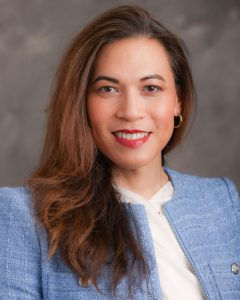 ant barriers, including that there had been no ophthalmology research previously done there. Dr. Hau reached out through her professional network, collaborated with research coordinators, and secured partnerships with pharmaceutical sponsors to establish an infrastructure. Hai Linh T. Kerrigan, PharmD, Division Research Administrator at the Department of Research & Evaluation, connected her with resources including introducing her to Bethlehem Mengesha, MPH, who became her project manager.
“I’m a physician and my expertise isn’t in the ins and outs for administrative necessities,” Dr. Hau said. “But Bethlehem and Hai Linh helped me get the necessary resources, such as contract expertise, to launch the research program.
Another way that Dr. Hau was able to pull together the necessary resources was she teamed up with the optometry department at Riverside to perform necessary exams for patients. Oftentimes optometry and ophthalmology exist in separate silos, but Dr. Hau decided to bridge the gap between them.
“That helped solve a huge bottleneck that would have prevented doing these retinal clinical trials at Kaiser Permanente,” she said. “Working together we were able to strengthen eye care service for the region.”
Their inaugural study launched in 2016
Their inaugural clinical trials launched in 2016 and focused on treating age-related macular degeneration (AMD), which is a leading cause of vision loss in people aged 60 and older. The disease causes symptoms like blurry vision, distorted straight lines, or blind spots, and to slow its progression, patients were getting once-a-month injections of medicine into their eyes.
One of those first clinical trials eventually led the team to investigate a revolutionary treatment, a bispecific antibody that acted upon 2 different receptors in the eye rather than just one. It found that the monthly injections could be spaced out to every 4 months.
“Not only did this allow patients to reduce their eye injections, but it’s also how we got our feet wet.” Dr. Hau said. “Even though we’d never done studies before, it proved to the pharmaceutical companies that we were capable of doing it. And because of those first studies, other people started considering us.”
Early work laid groundwork for medical breakthroughs
Those achievements laid the groundwork for subsequent studies in sustained drug delivery, gene therapy, and stem cell therapy, positioning Riverside as a leader in ophthalmic innovation. Her team has since been involved in over 20 different clinical trials leading to FDA approval for 4 distinct therapeutics treating the leading causes of visual impairment in the US: age-related macular degeneration, retina vein occlusions, diabetic macula edema and diabetic retinopathy.
Dr. Hau leads with energy and a passion for collaboration, said Dr. Kerrigan.
“From the start, she shared a bold vision of establishing Kaiser Permanente as a center of excellence in ophthalmology research, and that vision continues to inspire our work,” she said. “Her enthusiasm for innovation and clinical discovery creates an environment where it’s easy to lean in, explore possibilities, and rally around projects that improve patient care.”
Surgical procedures added to clinical trials
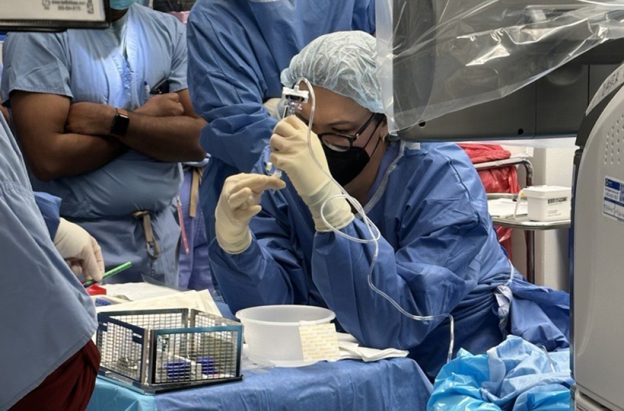
Dr. Hau transitioned her team from clinical trials with injected medications to surgical trials that further expanded sight-saving possibilities.
In 2021, she enrolled a patient with diabetic retinopathy, which is a leading cause of vision loss in working-age adults, into a trial that involved implanting a tiny, refillable device called a port delivery system.
This device continuously released medicine directly to the back of the eye, reducing the need for monthly injections to just refills every 6 to 12 months.
“Now we weren’t just working in the clinic, we were also in the operating room,” Dr. Hau said. “There were a lot of people in the operating room excited to be a part of the clinical trial.”
The work marked the first use of this treatment at Kaiser Permanente, improving patient quality of life and helping pave the way for FDA approval.
“It was the first time the treatment had been used at Kaiser Permanente,” Dr. Hau said. “This pioneering work not only improved the patient’s quality of life but also helped pave the way for FDA approval of the device, making this breakthrough available to many more people in need.”
Programming the eye to heal itself
Soon Dr. Hau and her team ventured into the world of gene therapy clinical trials. Gene therapy helps the eye produce its own proteins that help stop unwanted blood vessels from growing in the eye.
The first of these forays into gene therapy occurred in 2024, when Dr. Hau did an injection into a patient’s eye to program the eye to make its own medicine to treat itself.
“It’s been more than two and a half years, and he hasn’t needed an injection since,” Dr. Hau said.
Building on the success of the injection therapy in 2025, Dr. Hau led Riverside Medical Center’s first surgical gene therapy trial for wet age-related macular degeneration with the one-time gene therapy.
“The treatment procedure directs the eye’s own cells to make the medicine needed to fight vision loss from the growth of extra blood vessels in the eye that can leak,” Dr. Hau explained. “We’re programming the eye to make the medicine that we currently give every month or two.”
As of March 2026, neither patient needed an eye injection.
Regrowing what was lost
Then, in September 2025, Dr. Hau pioneered another first for Kaiser Permanente: a clinical trial designed to give hope to those who have almost entirely lost their vision. Among the patients who were eligible for this trial were those whose retinas had been destroyed by macular degeneration, leaving a scar within the eye.
“As a field, we’ve tried to transplant retinas with limited success but in this clinical trial we were instead injecting stem cells next to the scar in hopes they will create new cells,” Dr. Hau said. “Some of these stem cells can differentiate themselves into retina cells and they can grow into other retina photoreceptor cells so that eventually the hope is it will form connections with the nerve and eventually the brain.”
The surgery was only the 17th performed in the world.
The patient is still doing well. In fact, she shared a story with Dr. Hau:
Before her groundbreaking surgery, she had to continually remind her husband to yell out her name so she could find him in the waiting room after appointments. She couldn’t see him waving. But 3 months after the procedure, everything changed. For the first time in years, she spotted her husband joyfully waving at her from across the room.
Dr. Hau will present the initial clinical trial Phase 1b results in May at a major international conference, the 2026 Association for Research in Vision and Ophthalmology (ARVO) Annual Meeting.
Building a legacy
Her work has brought national attention to Kaiser Permanente Southern California, contributing to its reputation as an excellent site for clinical trials. Patients benefit not only from access to novel therapies but also from comprehensive support, education, and care coordination provided within Kaiser Permanente’s integrated system.
She attributes her success to supportive leadership, research partners, Dr. Kapil Sampat, and staff willing to embrace new ideas: “I had the right collection of people who are like-minded, who saw my vision, and who were willing to stick their neck out a little bit and support me.”
Recently, she launched the first clinical trials primary investigator development workshop through the American Society of Retina Specialists, aiming to increase diversity among researchers and, in turn, among patients in clinical trials.
“We were doing it for the very first time,” Dr. Hau said. “I would have been happy to have 20 people signed up but we sold out at 80! I would have gotten more but we were limited by the size of the room.”
Clinical trials will lead to brighter future
The implications of Dr. Hau’s clinical trials are far‑reaching. For patients, they offer hope — hope for fewer treatments, better outcomes, and, in some cases, restored sight. For the medical community, they signal a new era in ophthalmology, where sustained‑delivery implants, durable gene therapy, and cell‑based regeneration may stand alongside standard care.
“Dr. Hau is a rare combination of clinician, innovator, collaborator, and leader,” Dr. Kerrigan said. “Her dynamic approach and unwavering commitment to excellence have elevated ophthalmology research within Kaiser Permanente. Her impact will be felt in both the advancement of science and the quality of care for our patients.
Beyond conducting clinical trials and inspiring physicians to engage in clinical trials, Dr. Hau says her ultimate goal is to bring hope to those who are losing vision.
“We may not be able to eliminate blindness,” she acknowledges, “but by developing these procedures we may give people back the ability to navigate the world.”