



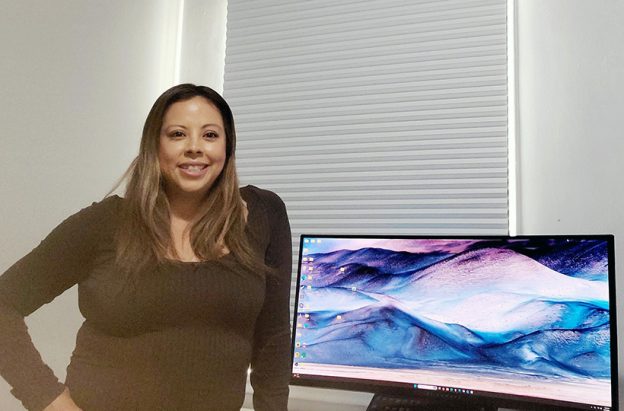
Nurses in research: Beatriz Alviso advances patient-centered science
This week, Nurses Week (May 6-12, 2026), we honor all the nurses who work within the Department of Research & Evaluation, who are a vital part of our research. Here we highlight Beatriz Alviso, RN, PHN, BSN who works in the Division of Health Services Research & Implementation Science.
What is your background?
I grew up rollerblading in the streets of Norwalk, California. I initially wanted to become a nurse when I was deployed overseas in Iraq as a preventive medicine specialist. There, I helped carry patients on the helicopters but wished I knew more hands-on care for emergency situations. So, when I returned home from the Army, I worked selling sunrooms while going to school to become an LVN, RN, and then getting my bachelor’s at Cal State San Marcos. I started working as an RN in a skilled nursing hospice facility in 2010, then moved onto an ophthalmology clinic, and then started in hospice and home-based palliative care throughout Los Angeles County.
I started working at Kaiser Permanente as a palliative care case manager in November 2018 visiting patients discharged from the hospital who were on hospice or palliative care. In that job, I visited patients who were on chemotherapy and radiation treatments and who were part of clinical trials. The idea of clinical trials and research really interested me and led me to want to see how research could be beneficial for my patients. I started working at the Department of Research & Evaluation in 2023.
What skills or qualities do you think are essential for nurses working in clinical research?
Great communication is essential to working as a nurse in clinical research where we are assisting patients in various settings. A research nurse should have curiosity and a passion for learning to discover ways to enhance performance and improve patient care. Compassion is essential for understanding patients so we can better help them manage their challenges.
Can you share a challenge you’ve faced as a research nurse and how you overcame it?
One challenge I faced while working on the Detect CID (Cognitive Impairment and Dementia) Study involved a patient who had recently been diagnosed with mild cognitive impairment and was also the primary caregiver for her husband with dementia. During a joint call with the patient and her daughter, I provided education by suggesting various future care options, sharing available resources, discussing goal-setting strategies, and encouraging family meetings. Their family included 8 children, so I recommended involving them to help reduce stress. Working in research often presents situations where we might need to have creative ideas to help identify solutions that best support patients.
What motivates you to continue working in clinical research?
What motivates me to continue working in research is the support from my team and the exposure to possible new treatments that may help patients in the future. It’s rewarding for me to be involved in research that allows me to guide dementia care partners by providing resources, teaching about the illness, and advising on ways to manage challenging behaviors such as hallucinations. I had a patient that would see someone else in the mirror. So, I educated them on covering the mirror or using a night light if they saw things in the night time, which might help reduce their fear. I also enjoy helping patients find ways to change certain lifestyle factors to improve their brain health.
Is there a particular research program that stands out in your memory, and why?
The Detect-CID Study stands out to me. My grandfather, a businessman whose career ended due to dementia, sparked my interest in dementia care and research. For many years, I provided palliative care to patients at different stages of dementia in their homes and I hope the work I’ve done in research with early detection of dementia in primary care helps patients and families better plan for their future.