



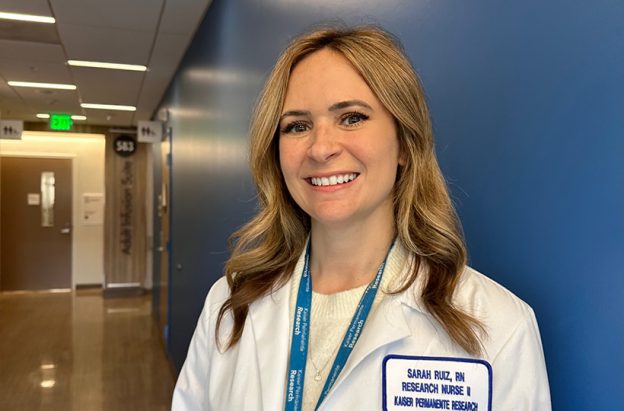
Nurses in research: Sarah Ruiz supports pediatric patients through clinical trials
This week, Nurses Week (May 6-12, 2026), we honor all the nurses who work within the Department of Research & Evaluation, who are a vital part of our research. Here we highlight Sarah Ruiz, BSN, RN, PHN, who works in bone marrow transplant and pediatric clinical trials.
What is your background?
I grew up in Texas, primarily the hill country surrounding Austin and then later lived in Austin as a young adult. I earned my Bachelor of Science in Nursing from Cal State LA. Prior to nursing, I worked as a flight attendant for Delta and United Airlines, where I assisted during in-flight medical emergencies. Those experiences sparked my interest in health care and motivated me to pursue nursing so that I could provide a higher level of care. Early in my nursing career, I worked at the bone marrow transplant unit of Children’s Hospital LA where I was introduced to clinical research. Collaborating with research nurses and learning about the impact of clinical trials solidified my interest in this field. Kaiser Permanente has long been a professional goal of mine due to its strong reputation for excellence, innovation, and patient-centered care. I am honored to be a part of an organization that prioritizes both clinical quality and advancement through research.
What skills or qualities do you think are essential for nurses working in clinical trials?
Clinical trials require strong organizational and multitasking abilities to manage complex protocols, along with critical thinking to ensure patient safety and protocol adherence. Equally important are empathy, patience, and kindness as patients are navigating serious illnesses. Clear communication skills are essential for educating patients, coordinating with multidisciplinary teams, and ensuring informed participation throughout the trial process.
Can you share a challenge you’ve faced as a clinical trials nurse and how you overcame it?
One of the most challenging aspects of this role is the loss of patients to cancer. I approach this by focusing on the meaningful impact clinical trials can have, whether that is extending time with loved ones or contributing to advancements that benefit future patients. I also see positive outcomes in other patients and in the collective progress being made through research.
What motivates you to continue working in clinical research?
I am motivated by the tangible impact clinical trials have on patient outcomes and the advancement of medical knowledge. Being part of a team that is dedicated to innovation and patient-centered care, particularly here at Kaiser Permanente, reinforces my commitment to this field.
Is there a particular clinical trial that stands out in your memory, and why?
Clinical trial AALL1731, a phase 3 trial involving children. This trial evaluated the addition of blinatumomab to standard chemotherapy in newly diagnosed patients with standard-risk B-cell acute lymphoblastic leukemia. The study resulted in a significant improvement in 3-year disease-free survival with the addition of blinatumomab compared to chemotherapy alone. It is inspiring to see such meaningful progress, and I am proud that Kaiser Permanente’s pediatric team contributed to this advancement. Being part of the work that directly improves outcomes for patients is deeply meaningful.