



5 questions for Dr. Hui Zhou
Hui Zhou PhD, MS, is the biostatistician lead in the Division of Epidemiologic Research for the Department of Research & Evaluation. There she collaborates with epidemiologists and clinical investigators on research studies ranging from conditions like hypertension, diabetes, chronic kidney disease, cardiovascular disease, and bone fractures. Dr. Zhou has extensive research experience in prediction model development and validation of health outcomes. She is highly skilled in developing and validating health outcome models using advanced statistical methods.
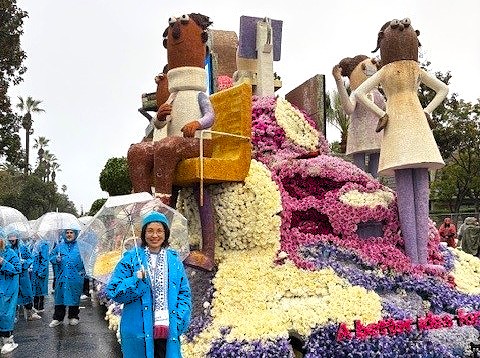
She also happens to be the mother of Serena Guo, this year’s Rose Queen. The Rose Queen is a Pasadena tradition dating back to 1905. The queen embodies the spirit of the Pasadena Tournament of Roses and represents Southern California pride. She also rides in the annual Rose Parade and attends the Rose Bowl Game on New Year’s Day. Dr. Zhou also walked in this year’s Rose Parade.
Dr. Zhou, let’s first talk about your work. How did you come to be a research scientist biostatistician?
My path to becoming a research scientist biostatistician has been shaped by both my scientific curiosity and the evolution of my life outside of work. I began my career in basic science. I earned my first PhD in Biochemistry and Molecular Biology in China and then came to University of Southern California to conduct stem cell and cancer research. At that time, I was very driven by the idea of making a discovery that could change the world, and I spent countless hours in the lab pursuing that goal.
After I had my 2 daughters, I realized I needed a career that still challenged me intellectually but allowed for better balance. That’s when I transitioned into biostatistics. I joined R&E in 2011 as a Biostatistician I. What surprised me was how much I enjoyed working on research that was directly connected to patient care. The impact felt immediate and meaningful, and it motivated me to deepen my understanding of the methods behind the work.
With the support of my managers at the time, I pursued a PhD in Epidemiology at USC while continuing to work full-time. My colleagues were incredibly generous with their guidance. And I grew a lot through collaborations with our department’s epidemiologic and biostatistics leadership. They recognized my passion and encouraged me to step outside my comfort zone and take on a more scientifically challenging position.
Eventually, that led me to the research scientist biostatistician role. I believe I am the only person in this position who started their career in R&E as a Biostatistician I. That really reflects the culture of our department — one that values growth, curiosity, and potential over where someone begins. My journey has been unconventional, but it’s been supported every step of the way, and it’s made me the scientist I am today.
Tell us what it’s like to be a research scientist biostatistician? How do the interactions work between you and other research scientists? What does your work add to Kaiser Permanente research?
Being a research scientist biostatistician means I have the privilege of working right at the intersection of scientific ideas and rigorous methodology. Research scientists and clinician investigators bring the content expertise and the big questions, and my role is to help shape those questions into studies that can be answered with valid designs and appropriate statistical methods. We work very collaboratively, from early study design meetings to ongoing check‑ins with analysts, to ensure data quality and refine methods as new findings emerge.
Because Kaiser Permanente has one of the most comprehensive health care databases in the world, our work can directly influence patient care and policy. That’s why getting the design and analysis right is essential. What I contribute is the assurance that our conclusions are scientifically sound and trustworthy. Our goal is to help make sure every project stands on a strong methodological foundation.
How does your work at Kaiser Permanente inform your role as a mother?
My work at Kaiser Permanente actually informs my role as a mother in meaningful ways. As a research scientist biostatistician, I’m constantly reminded of how important evidence, careful thinking, collaboration, and respect for different perspectives. That also applies to parenting. I try to teach my children to ask good questions, think critically, understand the “why” behind things, and most importantly, respect others no matter how they are different from us.
I often talk about my work at home. During the COVID‑19 shutdown, we had to share the same study room, so they overheard discussions about vaccination, cardiovascular disease, chronic kidney disease, and opioid use disorder, and many other topics. Those conversations sparked their curiosity. My younger daughter, 16, developed a passion for medicine and began volunteering at USC Arcadia Hospital after the pandemic. My older daughter, 18, and the Rose Queen, used her understanding of health care systems in her student congressional debate work.
In addition, since Kaiser Permanente values communities and equity so much, I have been volunteering whenever I can. By watching me, my children have joined various nonprofit organizations and found their way to help others.
In many ways, my job helps me show my kids what it looks like to be curious, caring, responsible, and part of something bigger than yourself.
You walked in the Rose Parade with the Kaiser Permanente float. What was that like?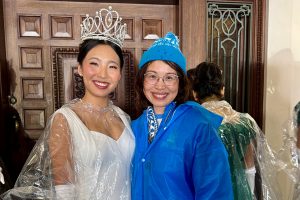
Ringing in the New Year by participating in 2026 Rose Parade was a once-in-a-lifetime experience that I will cherish for a very, very long time. This event had dual meaning for me both as a mom and as a scientist: This year represents my 15-year anniversary with Kaiser Permanente, and I was the proud mom of the Rose Queen!
This all reminds me how fortunate I am to work in Kaiser Permanente, especially in the department of R&E where I not only work with a group of intelligent, smart and passionate people but also with supportive and understanding friends. Our successes together show the magic of team work. And I am still able to succeed in my personal life as a mother who has raised 2 amazing children.
Walking in the parade and knowing my daughter was there was one of the important parts. Seeing Serena in her role as Rose Queen was surreal. And being part of Kaiser Permanente and recognized in that setting made me even prouder. It felt like all the pieces of my life came together in one unforgettable experience.
What do you like to do in your spare time?
In my spare time, I love exploring new experiences, especially through food and travel. I’m the kind of person who can’t resist trying every restaurant, boba shop, or coffee stand I come across, and I rarely order the same thing twice. My kids tease me for tasting “weird” foods, including fried scorpion, but I enjoy discovering flavors from all over the world.
I also love organizing group trips. When I have longer vacations, I explore different countries and often bring multiple families along. Many of my long‑term friends trust my planning so much that they say they’re always “on call” for my next adventure. Their entire families — from grandparents to young kids — will adjust their schedules to join, even if they don’t know anyone else in the group besides me. In recent years, I’ve led 5 families (20 people) on a 2‑week road trip through New Zealand, and another 4 families from Canada, China, and the U.S. on a memorable journey through Japan. For me, sharing experiences with others makes every trip even more meaningful.
Photo caption 1: Dr. Hui Zhou with the 2026 Kaiser Permanente Rose Parade float.
Photo caption 2: 2026 Rose Queen and Arcadia High School senior Serena Guo with her mother, Dr. Hui Zhou.