




Five questions for Dr. Casey Luc
Casey Luc, PhD, MPH, an epidemiologist with expertise in HIV epidemiology in underserved communities, is the fifth Centers for Disease Control and Prevention Epidemic Intelligence Service officer to train with Kaiser Permanente Southern California’s Department of Research & Evaluation. Before joining Kaiser Permanente, he served as a health scientist contractor in the Syndemic Infectious Diseases Bureau at the Chicago Department of Public Health, where he led research projects focused on HIV and sexually transmitted infection prevention and treatment. As an EIS officer, Dr. Luc is expanding his expertise in applied epidemiology through a dual appointment with R&E and the Pasadena Public Health Department.
What inspired you to pursue a career in research?
As a kid, I was always interested in “I Spy” books. They’re a series of picture books in which you’re given a list of items to find, and you scour these large, beautiful photographs to find each of the hidden objects. The images can appear chaotic and messy at first, but as you make sense of them using the list of items to find, you start seeing patterns in the imagery and eventually uncover the objects. I think that sense of discovery, of making sense of something that initially appears chaotic and messy, has served as a foundation for my interest and curiosity in research. At its core, research is about taking data, whether from a small cohort study or a health care database with millions of members, and making sense of that complexity to say something meaningful. My passion continues beyond simply finding something in the data, though. What makes research especially rewarding to me is the potential for those discoveries to have a positive impact on population health.
Recently, you supported the CDC during the Cyclospora outbreak in Ohio. Can you describe your mission and how you approached it?
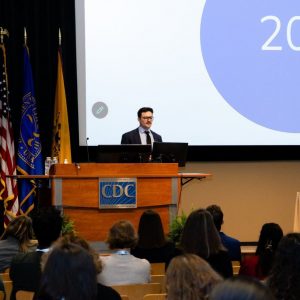 I was recently selected to support a CDC response to the Cyclospora outbreak in Ohio. I’m part of the Epidemic Intelligence Service, a 2-year postgraduate fellowship in applied epidemiology. One of the core functions of the fellowship is responding to and investigating domestic and international public health emergencies, such as the Cyclospora outbreak. When CDC sends EIS officers on these responses, called Epi-Aids, we support local health jurisdictions in whatever capacity is needed based on the emergency. Because of our advanced training in applied epidemiology, 4 other EIS officers and I were asked to assist the Ohio Department of Health with the thousands of Cyclospora cases they were investigating. During the 3 weeks we were in Ohio, we supported data collection and management, merged 2 surveillance data systems used to collect information on cases, and conducted preliminary analyses to help describe the outbreak. We’ll continue assisting Ohio throughout the response, with the goal of disseminating what we learn through future presentations and manuscripts. Separately, I’ll continue supporting the overall response to the multistate Cyclospora outbreak through CDC’s Emergency Operations Center over the coming months.
What research at the Department of Research & Evaluation are you most excited about?
It’s difficult to choose just one. I’ve enjoyed the diversity of topics I’ve been able to work on under the supervision of Dr. Sara Tartof. I’ve written a manuscript on elevated blood lead levels in children, presented on a dengue seroprevalence study using KPSC remnant blood specimens, and am involved in ongoing projects on invasive pneumococcal disease, COVID-19 severity, and much more. I’ve valued the opportunity to work across such a broad range of topics.
What is your ultimate dream for your career?
Overall, I’d like to be in a leadership position where I can use large-scale data sources to continue doing advanced epidemiologic research and address important public health questions. I’m flexible about where that might take me, but I know I want to continue doing research that is both rigorous and meaningful.
What do you like to do in your spare time?
I’m really interested in music of all kinds. You’ll find me at record stores, listening to records at home, or at a concert or music festival. I really enjoy exploring different genres and discovering new music through records because there’s something special about being able to sit down and listen to an album from beginning to end.
Photos:
Dr. Luc doing something he enjoys: Attending Coachella.
Dr. Luc giving a presentation at the 2026 EIS conference.